


Behavioural biases can quietly undermine credit portfolio performance. In this sponsored content from Franklin Templeton, the investment management firm shows how its analysis of US investment grade managers reveals five common strategy types – and a sixth that may offer a more resilient path forward.
The hidden forces behind credit allocation
Institutional investors, particularly those managing liability-hedging portfolios, rely on their credit allocations to deliver long-term, stable returns. Yet even the most sophisticated strategies are vulnerable to behavioural biases – subtle, often subconscious tendencies that distort decision-making and lead to suboptimal outcomes.
To explore how these biases play out in practice, we analysed the trades, positioning, and performance of active managers in the US investment grade credit market. This revealed five distinct behavioural types, each with predictable outcomes across different market environments. We also identified a sixth, bias-aware approach that seeks to exploit structural inefficiencies – offering investors a potentially more resilient path forward.
Analysing the investment universe
Our study focused on 75 strategies within the eVestment US long duration credit universe. We examined key dimensions such as:
- Duration: sensitivity to interest rate changes
- BBB exposure: willingness to take credit risk
- Tracking error: deviation from benchmark risk factors
We also assessed how managers adjusted portfolios in response to shifting market conditions. Did they adapt, or remain anchored to previous positions? The results revealed five broad behavioural models.
Five common manager types
- Yield Hoarders
The most prevalent type, Yield Hoarders seek to out-yield the benchmark by overweighting BBB-rated securities. This strategy often pays off in bull markets but can backfire in downturns due to overconfidence and risk concentration.
- Gloom boomers
These managers take a more conservative stance, often underweighting riskier assets. Their cautious approach helps in volatile or declining markets but can lead to missed opportunities during rallies. Loss aversion is their defining bias.
- Value Timers
Attempting to anticipate market inflection points, Value Timers adjust portfolios based on perceived turning points in rates or spreads. However, their reliance on the gambler’s fallacy – expecting reversals after trends – often results in poor timing and underperformance.
- Macro Elephants
Driven by top-down macro views, these managers anchor to long-term theses. While this can work when macro calls are correct, it limits flexibility and often overlooks bottom-up opportunities, reducing alpha potential.
- Closet Indexers
These managers actively trade but stay closer to benchmark risk profiles. Their tendency to herd limits their ability to capitalise on mispricing. Performance is typically marginally positive in both up and down markets, but rarely exceptional.
A sixth way: Structural Advantage
While all managers face behavioural challenges, our analysis suggests a sixth, more deliberate approach – what we call Structural Advantage. This framework combines intentional portfolio construction with tools designed to minimise behavioural bias. It emphasises:
- Neutral beta and duration relative to benchmarks
- Balanced credit quality exposure
- Bottom-up idea generation supported by quantitative tools
By avoiding emotional and cognitive bias, this approach aims to deliver consistent performance across market cycles. It doesn’t chase yield or rely on macro calls – instead, it seeks to exploit structural inefficiencies in the credit market.
Behavioural biases in action
To test the validity of these behavioural categories – including Structural Advantage – we examined manager performance over the past seven years. In doing so, we identified three key six-month periods – H1 2019 (risk-on), H2 2022 (risk-off), and late 2024 to early 2025 (risk-on) – that revealed clear patterns.
Historical performance in risk-on and risk-off environments
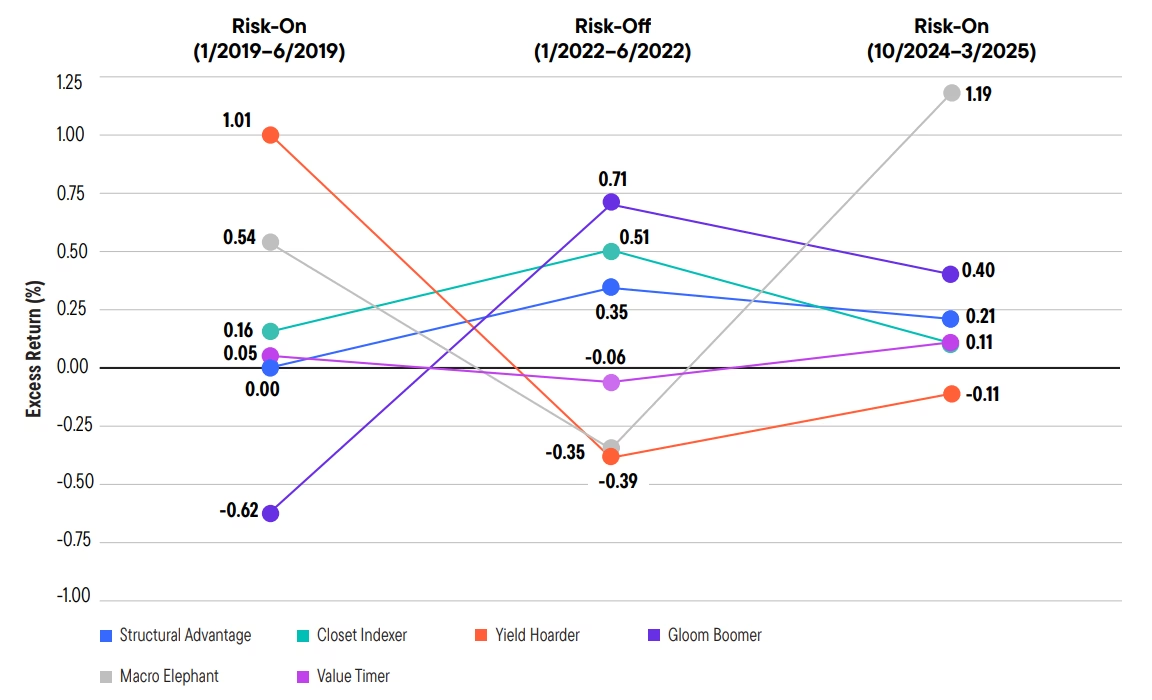
eVestment, as of 31/3/2025. Performance is shown gross of fees. Time periods used in this demonstration were selected as times over the course of the track record when option-adjusted spread levels on the Bloomberg US Long Credit Index widened over 25 basis points or more.
Each manager type broadly behaved as expected. Yield Hoarders outperformed in rallies but lagged in downturn; Gloom Boomers did the opposite. Value Timers and Macro Elephants showed inconsistent returns, while Closet Indexers hovered relatively near the benchmark.
The Structural Advantage strategy showed a more consistent pattern – flat or modest outperformance in up markets and stronger relative returns in down markets. This suggests that a bias-aware, structurally focused portfolio could offer a more resilient path forward.
Conclusion: rethinking manager selection
Our research highlights the real-world impact of behavioural biases on credit portfolio performance. While no strategy is inherently flawed, understanding how different approaches behave in various market conditions is essential.
Investors should be cautious of overexposure to similarly biased strategies, which can compound underperformance. Diversifying across behavioural types – or exploring frameworks like Structural Advantage – can help mitigate bias and support more consistent alpha generation, regardless of market conditions.

For more information, please click here.