


Grid capacity is transitioning from an operational consideration to a material determinant of location, value and liquidity in real estate investments. Taking appropriate action could secure investors a competitive advantage, says Florian Richter, senior director, European investment research, real estate at PGIM.
- Electricity demand is rising faster than network investment, while European grid permitting and construction timelines remain long.
- Connection certainty, capacity headroom and on-site energy capability are becoming drivers of development timing, asset value and liquidity.
- Investors should assess grid risk early, identify who bears it and secure mitigants before committing capital.
Grid capacity is becoming a material determinant of development timing, capital expenditure and asset liquidity across European real estate. In constrained markets, secured capacity, on-site generation or storage can support scarcity value, while inadequate access can delay business plans and weaken residual values.
Why grid scarcity is likely to persist
Electricity demand is accelerating faster than grid investment. The International Energy Agency (IEA) expects global demand to rise by an average of 3.6% annually between 2026 and 2030, 50% faster than in the preceding decade, as transport, heating and industry electrify and AI-focused data-centre consumption roughly doubles[1]. Meeting this demand would require annual global grid investment to rise by roughly 50% from about $400bn[2].
The demand supply mismatch is increasingly structural. Renewable generation can typically be delivered in one to five years and data centres in one to three, while new high-voltage grid infrastructure often takes five to fifteen years[3]. In Europe, permitting and regulatory approval consume more than half that timeline – a delivery cycle two to four times longer than the renewable projects the grid is meant to connect[4].
Grid risk is spreading into mainstream real estate
Connection queues show the scale of the strain. Across 20 EU countries publishing transmission and distribution data, the estimated gap between planned renewable expansion by 2030 and available grid capacity has widened to 120 GW, equivalent to the electricity use of about 100 million homes[5].
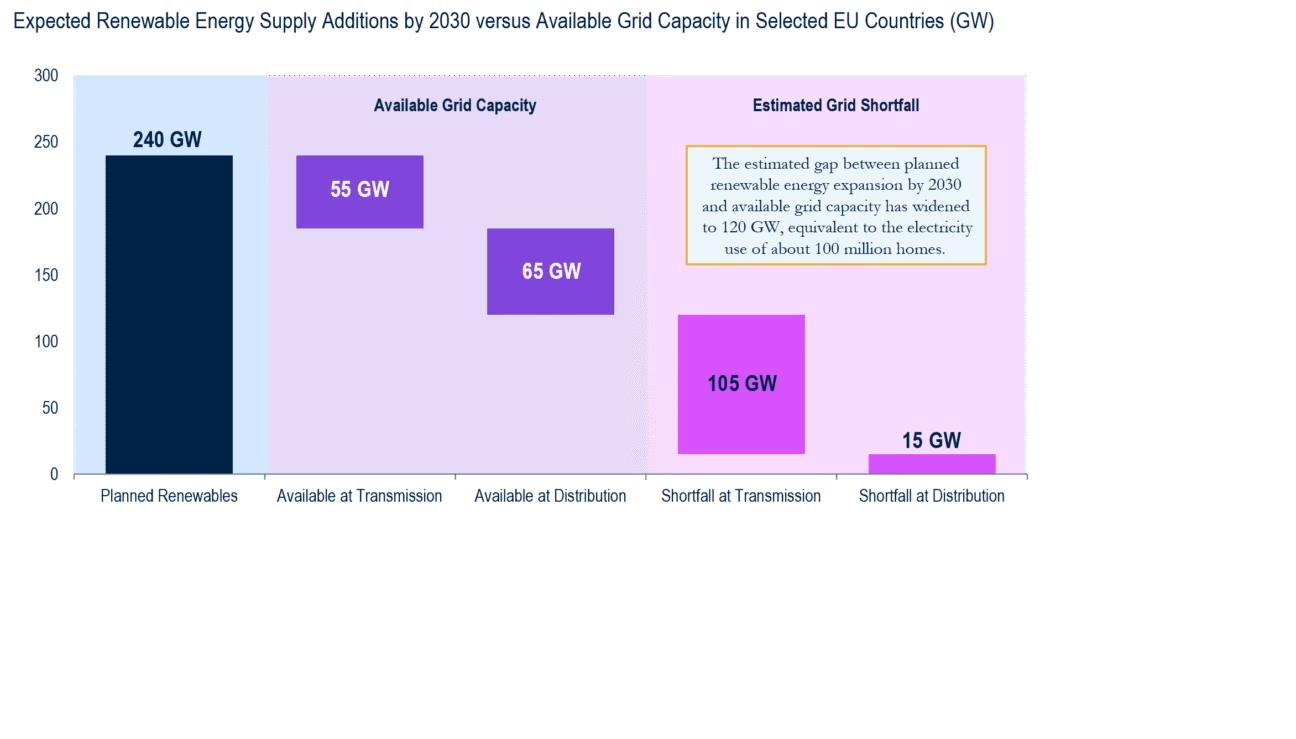
Source: Ember, PGIM. As of September 2026.
Digital infrastructure is the clearest real estate example for grid risk. In Frankfurt, London, Amsterdam, Paris and Dublin, grid connection lead times can reach seven to ten years, far beyond a typical two- to three-year data-centre construction programme[6]. But treating this as a data centre issue understates its reach. The Netherlands shows how scarcity is moving beyond data centres into mainstream property. The number of provinces reporting connection restrictions more than doubled between 2022 and 2024 and logistics properties in congested postcode areas have recorded materially higher vacancy than those in unconstrained locations[7].
The policy response – and its limits
Policymakers are responding. The European Commission’s European Grids Package proposes a revised Trans-European Networks for Energy regulation, an accelerated permitting directive, and guidance on efficient and timely grid connections[8].
At the regulatory level, the Council of European Energy Regulators (CEER) notes that several countries are introducing complementary queue-management measures, including project maturity assessments, financial guarantees, reservation deadlines and use-it-or-lose-it provisions[9].
In conjunction with broader national reforms, these measures should improve the allocation of scarce grid capacity toward viable projects, however, they do not materially increase underlying network capacity and cannot substitute for physical grid expansion.
Estimates suggest that Europe requires about €100bn of annual grid investment to remain on a Net Zero-consistent pathway to 2050, compared with actual investment of approximately €70bn in 2024, itself around 50% higher than five years earlier[10]. Against that backdrop, investors underwriting assets today should assume that grid scarcity is likely to persist through much of the development or holding period, easing unevenly across markets and potentially later than headline policy ambitions suggest.
Implications for real estate underwriting
Investors should assess grid access as a discrete underwriting variable: whether capacity is constrained, when that constraint could affect the business plan and which party bears the resulting risk. Mitigants should be secured before capital is committed, including connection capacity with headroom, on-site generation or battery storage, contingency capital and development milestones linked to grid delivery.
The valuation distinction is becoming visible. Two otherwise comparable assets are not economically equivalent if only one has a secured connection with spare capacity. An asset that cannot be expanded, intensified or electrified will appeal to fewer buyers and occupiers, making grid access a growing source of differentiation alongside energy performance.
Grid capacity is transitioning from an operational consideration to a material determinant of location, value and liquidity in real estate investments. Investors who explicitly assess grid exposure (or on-site energy production and storage) at acquisition are more likely to avoid delayed business plans and stranded development outcomes and, in the most favourable cases, may secure access to a competitive advantage that is becoming harder to replicate.
[1] International Energy Agency. Key Questions on Energy and AI. World Energy Outlook Special Report. Paris: IEA, 2026.
[2] IEA, Electricity 2026: Analysis and Forecast to 2030. Paris: IEA, 2026.
[3] IEA, Electricity 2026: Analysis and Forecast to 2030. Paris: IEA, 2026.
[4] Aurora Energy Research, The State of European Power Grids: A Meta-Analysis. Oxford: Aurora Energy Research, 2025.
[5] Ember, Crossed Wires: Grid Capacity Could Block EU Energy Security. London: Ember, 2026.
[6] Ember, Crossed Wires: Grid Capacity Could Block EU Energy Security.
[7] Savills, Grid Capacity Report: Out of Power, but Not Out of Options. Amsterdam: Savills, 2025.
[8] European Commission, “Commission Proposes Upgrade of the EU’s Energy Infrastructure to Lower Bills and Boost Independence,” press release, December 10, 2025.
[9] Council of European Energy Regulators [CEER], CEER Paper on Grid Connection Challenges, Ref. C25-DS-100-06. Brussels: CEER, 2026.
[10] Aurora Energy Research, The State of European Power Grids: A Meta-Analysis.
For Institutional and Professional Investors only.
All investments involve risk, including the possible loss of capital.
The information contained herein is provided by PGIM, the principal asset management business of Prudential Financial, Inc. (PFI), and a trading name of PGIM, Inc. and its global subsidiaries and affiliates.
Please visit the Important Disclosures page on www.PGIM.com for additional information.
This information is for informational purposes only and does not constitute investment advice, a recommendation, or a solicitation where prohibited. Certain information has been obtained from sources that PGIM believes to be reliable as of the date presented; however, PGIM does not guarantee its accuracy or completeness. Information may be changed without notice, and PGIM has no obligation to update it.
Any forward-looking statements, including projections or forecasts, are subject to change without notice and are not guarantees of future results.
PGIM and its affiliates may develop and publish research that is independent of and different from the information contained herein.
PFI of the United States is not affiliated in any manner with Prudential plc, incorporated in the United Kingdom (UK), or with Prudential Assurance Company, a subsidiary of M&G plc, incorporated in the UK.
© 2026 PFI and its related entities. All rights reserved.