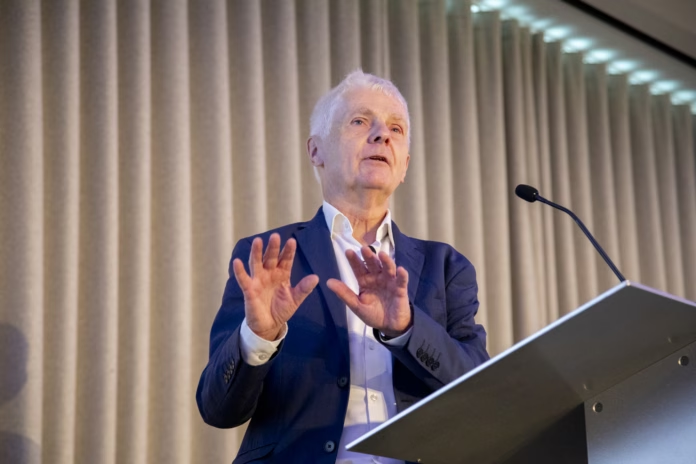


Ahead of Room151’s technology forum, Omid Shiraji, consultant CIO and non-executive director and advisor, talks about the urgent need for councils to stop treating digital, data and technology as a cost to cut.
Reader warning: if you think “cutting IT spend” makes you a hero, you might want to close this tab now.
Let’s be blunt. Every time a chief finance officer (CFO) or chief digital information officer (CDIO) proudly announces another 10% “saving” on digital, what they’re really saying is:
- “Let’s waste more taxpayer money keeping 1990s tech on life support.”
- “Let’s gift-wrap a £3m cyber incident for our auditors.”
- “Let’s demotivate our staff with clunky tools.”
- “Let’s keep our residents waiting while Amazon and Netflix show them what good looks like.”
Still feeling like a hero leader?
The reality is treating digital, data and technology (DDaT) as a cost line is killing us. Up to 80% of IT budgets are trapped in legacy systems. Councils pay six times more to run outdated tech than modern alternatives. A major cyber incident costs on average £3.2m. Add in wasted staff hours battling clunky workarounds, horrendous resident experiences of, what should be, simple council services, and those “savings” look less like prudence and more like budgetary vandalism.
And yet the same tired demands echo around the executive finance/tech table:
- “The IT budget needs to be reduced by (insert arbitrary salami-slicing percentage here)!”
- “Can we defer the next upgrade?”
- “Can we benchmark our way to the bottom?”
It’s the financial equivalent of cutting the brakes to save the fuel. Meanwhile, CDIOs are reduced to suppliers, cost centres and blockers, when they should be strategic partners driving productivity and value.
So what does good look like?
- A modern CFO balances value against risk, treating DDaT as a portfolio of investments rather than a drain on resources. They fund teams, not one-off projects and measure returns in productivity, resilience and resident outcomes.
- A modern CDIO is not a cost manager but an architect of organisational productivity. They embed DDaT into every decision, unlock new operating models, and design services around real user needs, not systems.
- Together, CFOs and CDIOs act as co-creators of long-term value, moving beyond salami-sliced cuts to compounding returns that strengthen the whole organisation.
What if we stopped asking how little we could spend, and started asking how much value we could create? Sustained, well-structured investment in DDaT builds “change muscle”. It compounds efficiency, enables automation, improves resident services and reduces whole-organisation costs. Digital, Data and Technology isn’t a balance sheet liability, it’s an investment that multiplies value.
That’s the shift we’ll be debating at the Room 151 panel “Shifting the Business Case Paradigm: from Cost to Investment” on 14th October at 4:05pm. Alongside Brian Mahon, MD of Moore Insight, I’ll be challenging the outdated mindset of some digital leaders acting as cost managers and finance treating DDaT as a line item to manage down.
We need to move away from capital funding of isolated programmes/projects and towards funding teams that deliver continuous and incremental change. We need portfolio investment approaches that builds an effective delivery engine over time. And above all, we need leaders on both sides of the table to mature, reframing digital, data and technology not as costs to control, but as the investment that underpins organisational survival.
If you’re still treating digital as a bill to trim, you’re not being prudent, you’re sabotaging your organisation’s future. The real choice isn’t between spending and saving. It’s between investing strategically now or becoming history later.
Omid Shiraji is a consultant CIO, non-executive director and advisor