


Technological innovation, demographics and favourable policy environments are the key structural factors creating attractive valuation opportunities in emerging markets, according to Edward Lees and Ulrik Fugmann, co-CIOs Environmental Strategies Group at BNP Paribas.
Executive summary
- Scale and structural demand are converging now: Emerging markets (EMs) are at the centre of both global growth and future energy demand, creating an immediate need for large-scale deployment of clean energy and its supply chain.
- Technology, policy and economics have aligned: Rapid cost declines, improving policy frameworks, and industrial upgrading mean environmental solutions in EMs are now commercially viable at scale, not just policy-driven – unlocking a step-change in deployment.
- Valuations lag fundamentals, creating a timely entry point: Despite strong earnings growth and central positioning in the global energy transition, EM equities – particularly environmental solutions companies – remain under-represented and discounted, offering a compelling opportunity to capture both growth and re-rating.
EMs now sit at the centre of the world’s economic transition and are the world’s supplier of AI infrastructure components and associated environmental solutions technologies. These countries comprise of 85% of the planet’s population and account for 52 % of global GDP growth since 2000. Yet, despite this outsized contribution, in our view, EM public equities remain markedly under‑represented in investor portfolios. This gap is now drawing increasing attention from long‑term investors seeking both growth and value, particularly as artificial intelligence and electrification-related power solutions take centre stage.
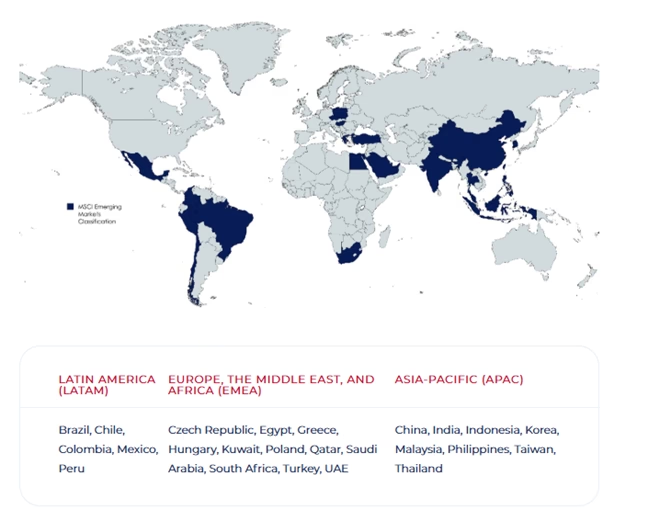
Source: Guinness Global Investors
A structural opportunity
Three broad forces are reshaping the EM landscape: technology innovation, demographics, and policy.
- Technology innovation – Over the past two decades, EMs – particularly in Asia – have moved up the manufacturing value chain. From low‑cost, labour‑intensive output in the 1960s, to today, where more than 65 % of workers are employed in industry and services, producing high‑value goods such as electronics, automotive components and clean‑technology equipment.
- Demographics – While many advanced economies are confronting ageing populations and rising dependency ratios (projected to reach 73 % by 2050), some of the larger EM economies continue to benefit from expanding workforces. A classic population‑pyramid shape still characterises many developing economies, delivering a sustained tailwind for consumption, productivity and entrepreneurship.
- Policy and Regulation – Centrally-planned decision‑making and the absence of legacy fossil‑fuel infrastructure allow many EM governments to roll out large‑scale renewable projects and other innovation initiatives far more quickly than in the West.
Together, these pillars create a “reinforcing dynamic”: modern, cost‑effective solutions fuel domestic growth while simultaneously positioning EM firms as exporters of the very technologies that will drive the global energy transition.
Valuation gaps remain wide
Even as earnings prospects improve, EM equities continue to trade at a discount to their developed‑market peers. As of June 2026, the MSCI EM Index was priced at 12x forward earnings, versus 21x for the S&P 500 and 16x for the MSCI EAFE index. The market’s historic risk premium – rooted in concerns about institutional strength, information quality, macro‑economic stability and investor base depth – still depresses EM multiples, but the gap is narrowing as governance and disclosure standards improve.
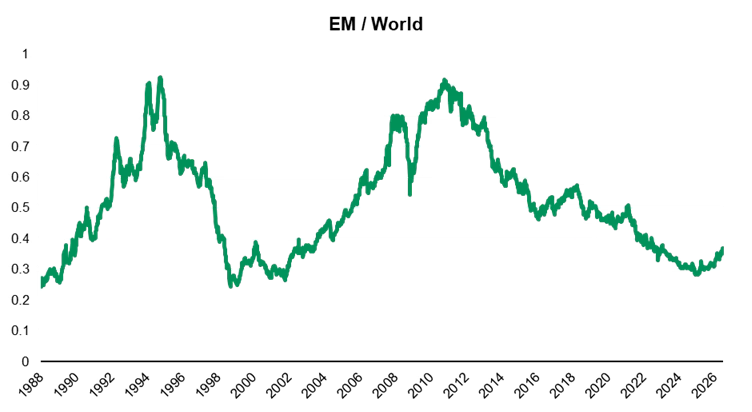
The ratio in the chart above divides the MSCI Emerging Markets Index by the MSCI World Index. When the ratio rises, emerging markets outperform developed markets – and when it falls, developed markets outperform emerging markets.
Source: BNPP AM via Long Term Trends
Perhaps the most striking metric comes from the sheer size of the investment universe. The broader market for publicly listed emerging market companies is roughly three times larger than the constituents in the highly concentrated MSCI EM Index. For actively managed funds focusing on this “long tail” of companies – often overlooked by more benchmark-aware investors – this creates access to differentiated and underexplored opportunity sets. These companies also tend to trade at a meaningful discount to the largest MSCI EM constituents, offering potential for enhanced alpha generation (performance above the benchmark).
Smaller EM firms – which make up the bottom ~85 % of the MSCI EM index weight in June 2026 – tend to operate in niche or highly localised markets, providing differentiated exposure that is rarely captured by the concentrated, large cap‑biased index. For investors seeking alpha, the opportunity lies in uncovering these under‑analysed assets, which may enhance diversification while aiming to deliver attractive risk‑adjusted returns over time.
The Environmental‑Solutions opportunity in emerging markets
The transition to a low‑carbon economy is reshaping capital flows, and EMs are emerging as key beneficiaries. Renewable‑energy capacity is expanding at an unprecedented pace in energy-dependent emerging markets, especially in the Asia‑Pacific region where clean‑energy investment is still heavily concentrated in a few large economies. For example, in 2025, India invested US$100 billion in clean energy – more than 2/3 of total spending on energy projects. Conversely, China is projected to add ~1,390 GW of renewable capacity between 2025 and 2030, 30% of total global renewable capacity additions.
These investments are not merely about meeting domestic demand. EM firms are increasingly moving up the value chain, producing everything from polysilicon and solar modules to batteries, hydrogen, fuel cells and grid‑system components. The region’s abundant mineral endowments – copper, lithium, nickel and cobalt – further cement its position in the global supply chain for electric vehicles and battery storage. For instance, global copper demand is expected to double to 50 million tonnes by 2035, while European lithium requirements could increase 18‑fold by 2030.
Risks and mitigants
Investing in EM equities is not without challenges. Political instability, less mature legal frameworks and currency volatility remain material risks. However, when combining the valuation discount, high expected earnings growth and emerging markets expertise, there could be an attractive risk‑adjusted investment opportunity. For globally oriented investors and portfolios, the inclusion of EM exposure can improve portfolio diversification: historically, blended portfolios of EM and developed‑market equities have delivered higher returns with only a modest rise in volatility.
Looking ahead
The next decades continue to see the structural forces at play in emerging markets. Urbanisation of emerging economies will continue rising from just over 50 % today to ~64 % by 2045. Rising incomes, a young labour force and increasingly supportive policy environments should see emerging markets enjoy above global average economic growth.
Emerging markets have emerged as the technology hardware leader of the world with critical components and materials for artificial intelligence revolutions and given its inherent energy-dependence with strong reliance of energy imports, has equally become one of the fastest growing areas for renewables capacity with home-grown clean energy technologies across a number of technologies.
Finally, climate‑related physical risks – sea‑level rise, extreme weather and water stress – has intensified the imperative for resilient, sustainable development, in emerging markets where climate change is having the most severe impact on people and society.
In this context, EM public equities are not just a “nice‑to‑have” exposure; they are a strategic asset class that delivers growth, value and a tangible link to the global transition toward a greener economy. Investors who look beyond the headline indices and tap into the broader, three‑times‑larger EM universe stand to capture meaningful alpha while contributing to the financing of solutions that could shape the world for generations to come.
Sources:
- Dodge & Cox; Emerging Markets: Why and Where; May 2024
- Rise of Asian Economies & Global Impact
- Over one-fifth of Chinese population older than 60, says official report
- Shifting Sands: The Demographic Drivers of Change in Emerging Economies
- Asia-Pacific to boost renewable energy capacity in 2026 despite geopolitical challenges, inflation | S&P Global
- Global Energy Trends: Clean Energy Growth and Rising Demand | World Resources Institute
- Emerging Markets: A Decisive Decade | S&P Global
- CLIMATE CHANGE: IMPACTS, VULNERABILITIES AND ADAPTATION IN DEVELOPING COUNTRIES
- Why invest in emerging markets | Guinness Global Investors
- https://www.longtermtrends.com/emerging-vs-developed-markets/
NB: All statistics, graphics and information have been sourced from BNPP AM or the sources linked below.
BNP PARIBAS ASSET MANAGEMENT Europe, “the investment management company”, is a simplified joint stock company with its registered office at 1 boulevard Haussmann 75009 Paris, France, RCS Paris 319 378 832, registered with the “Autorité des marchés financiers” under number GP 96002.
This material is issued and has been prepared by the investment management company.
Not for Retail distribution: This marketing communication is intended exclusively for Professional, Institutional, Qualified or Wholesale Investors/Clients, as defined by applicable local laws and regulation. Circulation must be restricted accordingly
Please note that articles may contain technical language. For this reason, they may not be suitable for readers without professional investment experience. Any views expressed here are those of the author as of the date of publication, are based on available information, and are subject to change without notice. Individual portfolio management teams may hold different views and may take different investment decisions for different clients. This document does not constitute investment advice. The value of investments and the income they generate may go down as well as up and it is possible that investors will not recover their initial outlay. Past performance is no guarantee for future returns. Investing in emerging markets, or specialised or restricted sectors is likely to be subject to a higher-than-average volatility due to a high degree of concentration, greater uncertainty because less information is available, there is less liquidity or due to greater sensitivity to changes in market conditions (social, political and economic conditions). Some emerging markets offer less security than the majority of international developed markets. For this reason, services for portfolio transactions, liquidation and conservation on behalf of funds invested in emerging markets may carry greater risk.