


Paola Binns, Head of Credit for Royal London Asset Management describes where the opportunity set can be found in these volatile markets
Increased geopolitical tensions and heightened macroeconomic uncertainty will always lead to reassessed investment assumptions and market volatility.
Looking at the current situation, tariffs will likely hurt the consumer through price inflation and hamper
GDP growth. Government bond yields and credit spreads have consequently been on the move.
What’s the noise?
There is downside risk for the US economy as Donald Trump’s administration embarks on a series of polarising and potentially harmful tariffs. There has been a notable shift in rhetoric from the US – in relation to its support for Ukraine and general alignment with Europe – which has set off alarm bells on the continent, resulting in potentially historic shifts in fiscal policy from Germany and other countries, in turn moving their government bond yields considerably higher.
Amidst this volatility, credit markets have behaved relatively calmly; whilst spreads have recently widened, this has been modest in absolute terms and the all-in yield of credit has led to renewed strong demand for the asset class.
It’s important to remember that performance comes from long term investing and not being dragged by day-to-day market movements.
Can spreads tighten from here?
While sterling investment grade all-in yields are attractive, their make-up has changed; even including the most recent spread widening, spreads have tightened significantly over recent years and government bond yields have not fallen as many expected they would. The result has been that a larger component of the all-in credit yield is from government bond yields. And the recent volatility we have seen in fixed income markets has been driven by underlying government bond yields responding to geopolitics and macroeconomic uncertainties.
With spreads having recently reached levels previously not seen since 2007 – pre-financial crisis – it is reasonable to ask whether following the very recent widening, such tight spreads are achievable again. Indeed, it is also fair to ask why spreads have not moved even more significantly wider let alone already begin to tighten back from those levels. The answer is that demand for the attractive yields from credit remains strong, with investors satisfied that, amidst higher geopolitical and macroeconomic uncertainty, fundamental credit risk is little changed. However, it’s important not to be complacent: just because the credit market has provided us with positive performance over recent years, with any setbacks short-lived, one cannot assume this will continue indefinitely, and some caution is therefore required.
The key aspect of our approach to active credit management is to make use of inefficiencies that provide attractive risk-adjusted return opportunities. The determining factor for flows into credit markets, currently, is quite clear, and ties into our approach: income. Investors want income. It is also worth noting that based on future rate expectations, we think that 10-year gilts look a good entry point at current levels. So, although spreads are near to historically tight levels, we believe that the potential for strong returns built on income looks attractive. It is up to us to find the best ways to access it in portfolios.
Figure 1: Sterling investment grade market credit spread
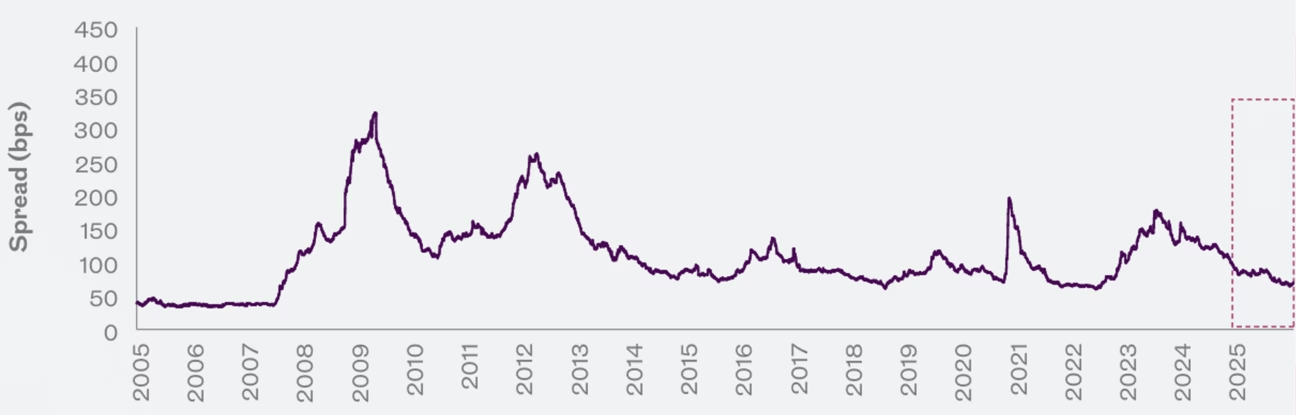
Source: Royal London Asset Management as at 28 February 2025. Chart shows spread on the ICE BoA ML Non-Gilts All Maturities Index.
Where are the opportunities?
While global geopolitical and macroeconomic uncertainties are affecting global government bond markets in different ways, and despite where credit markets have reached in spread terms, sterling credit still offers attractive sources of value for those prepared to look carefully. Our strategies continue to see value in financials – particularly subordinated debt, which offers good value and increased buying opportunities.
The sector is also seeing continued issuance, keeping bonds attractively priced. It must be noted that this has slowed slightly in recent months, however. We also maintain a high exposure to secured debt – representing a welcomingly diverse set of economic exposures with one critical commonality – a charge over assets. In an increasingly uncertain world, in an asset class with asymmetric risk and return profiles, the enhanced visibility and control from secured lending is hugely beneficial.
The ultimate attraction of secured bonds is that these enhancements remain under-appreciated and undervalued in a market that has largely developed as a conduit for unsecured finance. And such bonds have typically performed well in heightened volatility, seeing relatively modest spread movement. Even in times of volatility and uncertainty, portfolio managers have been reluctant to sell such assets to raise liquidity, and this has proven time after time to be a prudent approach.
Figure 2: Sector credit spreads
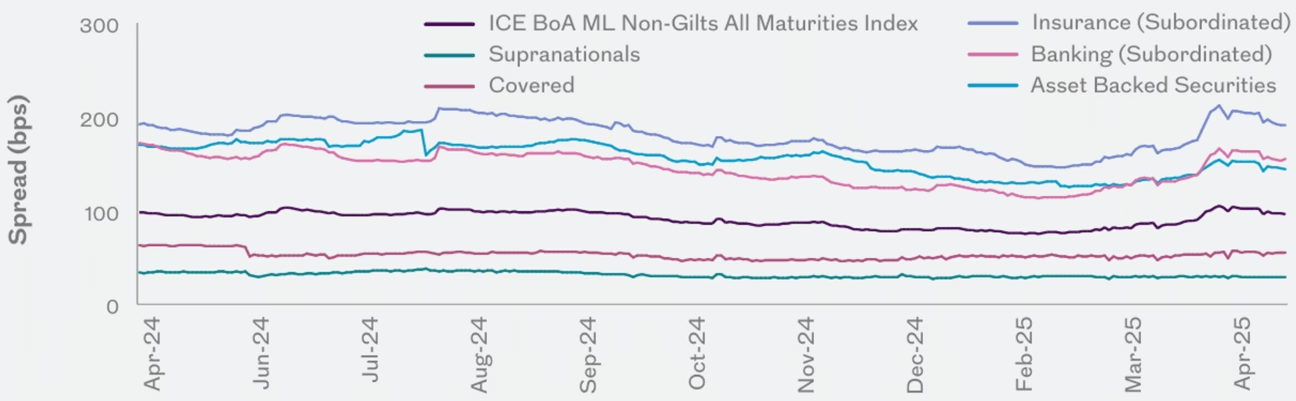
Source: Royal London Asset Management as at 28 February 2025.
Finally, investors have not been sufficiently more rewarded by yield for taking longer maturity exposure, particularly given the greater sensitivity to volatility in longer term underlying government bond yields; short duration funds generate similarly attractive income but have been far more stable. In our view, this is not likely to change soon.
Portfolio approach
In a diversified portfolio, we believe that we can generate good levels of income by taking appropriate levels of risk but ensuring, where possible, mitigation of those risks. There continue to be plenty of opportunities for us to add value in this way. While tariffs and sticky inflation continue to grab headlines, we don’t see the UK at the forefront of these pressures. We feel these market conditions continue to offer good value with plenty of opportunities to invest in sterling corporate debt.
Volatility can create attractive buying opportunities for our portfolios. Active managers are in a position to capture the new issue premia and take advantage of market uncertainty and weakness as it arises. But equally if not more important are the benefits of deeply embedded long-term value.
Important information
For professional clients only, not suitable for retail clients.
This is a financial promotion and is not investment advice. Capital at risk. Past performance is not a guide to future performance. The value of investments and any income from them may go down as well as up and is not guaranteed. Investors may not get back the amount invested. The views expressed are those of the author at the date of publication unless otherwise indicated, which are subject to change, and is not investment advice. Forward looking statements are subject to certain risks and uncertainties. Actual outcomes may be materially different from those expressed or implied.
Issued in June 2025 by Royal London Asset Management Limited,80 Fenchurch Street, London, EC3M 4BY. Authorised and regulated by the Financial Conduct Authority, firm reference number 141665. A subsidiary of The Royal London Mutual Insurance Society Limited.