CCLA Investment Management’s head of cash management Stuart Freeman and senior portfolio manager (cash) Rob Evans explain the “remarkable shift” that has occured in the past ten years.
For the geeks number crunchers among us, the ‘Borrowing and Investment’ tables that the Ministry of Housing, Communities and Local Government (MHCLG) publishes every quarter make fascinating reading.[1]
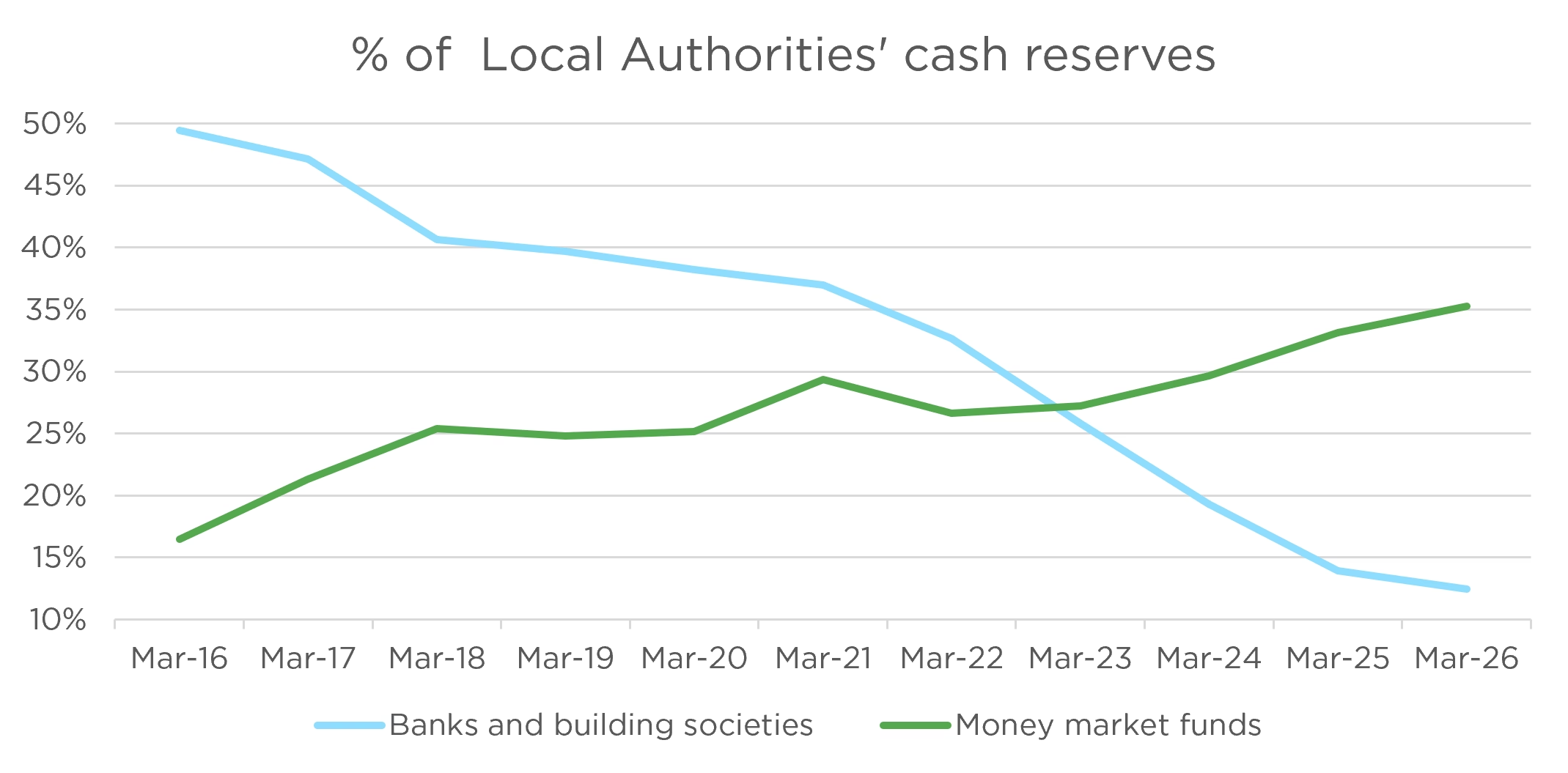
Just 10 years ago, local authorities predominantly held their cash reserves with banks and building societies. By the end of the 2022/23 tax year, money market funds had become as popular as banks and building societies.
Now, the most recent year-end numbers show that local authorities hold most of their cash reserves, c.£10.5bn, in money market funds. That’s about three times the c.£3.7bn that they hold with banks and building societies, a remarkable shift in just 10 years’ time.
Figure 1. Local authorities have moved their investments from banks to money market funds.
Source: Ministry of Housing, Communities and Local Government, Office for National Statistics, as of October 2026.
Why the shift from banks to money market funds?
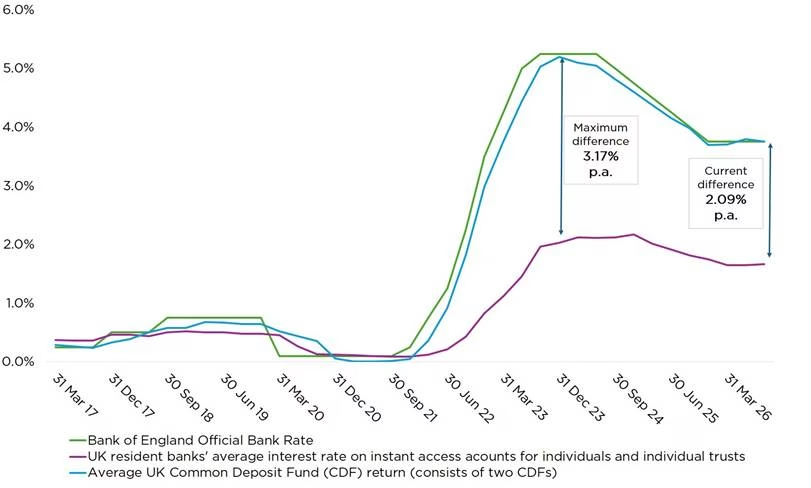
The first reason for this sea change is obvious. Money market funds are almost as easy to access as bank accounts, but they usually offer a higher yield. Commercial banks, on average, now offer well below 2% on your deposits. And if you keep your funds in longer-dated or fixed-term deposits, banks often penalise you for making an early withdrawal.
In addition, banks are quick to lower their deposit rates when the Bank of England cuts its Official Bank Rate (OBR), but slow to raise them when OBR is going up – as it is now.
By contrast, money market funds react quickly when the Bank of England raises its OBR. That’s why, over the past four years, the interest rate that money market funds pay has, on average, been two-and-half times higher than commercial banks’ rates!
Figure 2. Banks have been slow to pass on the Bank of England’s rate hikes. But money market funds have offered much higher yields for years, in line with the Bank of England.
Source: Bank of England, CCLA, as of November 2026. Past performance is not a reliable indicator of future results.
Secondly, most finance officers haven’t forgotten the near-collapse of Northern Rock in 2007 and several Icelandic banks in 2008. That’s why local councils don’t chase higher yields at all cost, but prioritise the security of their reserves.
As a result, many councils now prefer money market funds instead of relying on one single bank as their counterparty. Money market funds diversify your investment with them over tens of counterparties, all of which they constantly monitor.
October’s stock market volatility has further enhanced the attractiveness of money market funds. In unsettled conditions, many investors prefer to keep at least part of their portfolios in near-cash funds. Those currently offer inflation-beating yields without the volatility that comes with investing in shares.[2]
Thirdly, a growing number of finance officers have gained in confidence when it comes to money market funds – with good reason. Over the past 15 years, the Money Market Funds Regulations in the EU (2017) and in the UK (2018) have enhanced these funds’ liquidity and their transparency. As a result, money market funds are increasingly mainstream, and well-understood by auditors, accountants, consultants and finance officers.
Finally, local authorities are legally required to consider and report on ESG (environmental, social, governance) standards. Banks generally lend deposit monies to any of their clients, without checking their borrowers’ ESG standards or reporting on those standards to their depositors.[3] By contrast, a growing number of money market funds operate in line with ESG standards, on which they report back to their depositors.
Summary
A sea change over the past decade means that local authorities now prefer money market funds over banks or building societies to hold their cash reserves. That’s because money market funds offer higher yields, better security, near-instant liquidity and greater transparency. Some councils also like the fact that money market funds are generally more in tune with their ESG requirements than their banks.
[1] As of 31 March 2026. Local authorities borrowing and investments: UK live tables Quarter 4 2025 to 2026 January to March. https://www.gov.uk/government/statistics/announcements/local-authorities-borrowing-and-investments-uk-live-tables-quarter-4-2025-to-2026-january-to-march
[2] Grice, Maisie. ‘Money market funds surge in popularity as investors grapple market volatility’. CityAM, 7 October 2026. https://www.cityam.com/money-market-funds-surge-in-popularity-as-investors-grapple-market-volatility/
[3] Davey, Jasmine. ‘Durham students hold ‘Action Day’ protest over University’s Barclays links’. Palatinate, 22 March 2026. https://www.palatinate.org.uk/durham-students-hold-action-day-protest-over-universitys-barclays-links/
This document is issued for information only. It does not provide financial, investment or other professional advice. We strongly recommend you get independent professional advice before investing. The market review, analysis, and any projections in this document represent CCLA’s house view and you should not rely on them when making any investment decisions. Actual results could be significantly different than expected. We do not have to update or amend these. Past performance is not a reliable indicator of future results. The value of investments and the income from them may fall as well as rise. You may not get back the amount you originally invested and may lose money. The COIF Deposit Fund is categorised as a short-term low volatility net asset value money market fund under the Money Market Fund Regulation.CCLA Investment Management Limited are part of the Jupiter Group, and authorised and regulated by the Financial Conduct Authority.