
Falling collateral values, rising rates and cautious lenders are creating an unusually attractive entry point for investors argues Martin Barnewell, head of Commercial Real Estate Lending at Aberdeen Investments.
The best lending vintages tend to follow a reset: loans are written against values that have already fallen, at yields that reflect higher base rates, while the lenders who normally compete for the same deals are constrained.
We believe 2027 is shaping up to be that kind of year for commercial real estate lending (CREL), and that loans written in it could be among the strongest vintage the asset class has produced in recent years.
This article sets out the evidence for that view, what our own record through earlier dislocations shows, why real estate debt should be seen separately from corporate direct lending, and what it means for investors.
Why the vintage matters
A lender’s return is capped at the margin it is paid, so the outcome of a loan is largely settled on the day it is written. Three things matter most: the loan to value (LTV), which sets how far property values can fall before the lender’s capital is at risk; the interest cover, which shows whether rent comfortably pays the interest; and the margin earned over the benchmark rate. Investors in loans also earn an illiquidity premium, the extra return over similarly rated public bonds for holding something that cannot be sold as easily.
Lending against a reset
Property values have already been through one adjustment. CBRE data cited by RICS showed UK commercial property values falling by around 20% between July 2022 and February 2023,1 and MSCI recorded a 12.8% fall in all-property capital values in the final quarter of 2022 alone.2 Aberdeen’s analysis of Green Street data puts European values at around 20% below their 2022 peak.3
The next pressure is rates. The Bank of England recently raised interest rates from 3.75% to 4% at its 5 November meeting, its first increase since August 2023, and markets are pricing a further three or four quarter-point rises during 2027.4 The ten-year gilt yield is around 5.2%.5 Capital Economics expects UK all-property equivalent yields to rise from 6.6% at the end of 2025 to 6.9% by 2030, with half of that rise coming in 2026, while Colliers forecasts a small 0.3% fall in capital values this year before a recovery.6
Aberdeen’s House View also points to near-term pricing pressure from higher rates and geopolitical volatility, with potential for further modest falls.3 Our argument does not need a crash. It needs only that loans written in 2027 are struck against values that have already reset, at a time when lenders are constrained.
The arithmetic shows why this matters. The table below is illustrative and is not a forecast.
| Property value (2022 peak = 100) | Loan at 50% LTV | Loan as a share of 2022 peak value |
| 80 (around 20% below peak) | 40% | 40% |
| 72 (illustrative further 10% fall) | 36% | 36% |
| 64 (illustrative further 20% fall) | 32% | 32% |
Source: Aberdeen, Green Street. Values rebased to the 2022 peak. Scenario analysis is illustrative.
On the middle row, a loan at 50% LTV is equivalent to about 36% of the 2022 peak value. Values would have to fall by almost two-thirds from that peak before principal was at risk.
Higher rates move the pressure onto bank balance sheets
Higher rates hit existing lenders twice. They push down the value of the property securing their loans, and they raise the interest bill that borrowers must cover. Loans written at higher LTVs and thinner interest cover are hit first: covenants are tested, borrowers must find new equity or refinance on worse terms, and defaults rise.
We have seen this sequence on several occasions. Lenders in this position typically reduce leverage and step back from new lending, and spreads widen for those who remain.
Aberdeen’s counter-cyclical record
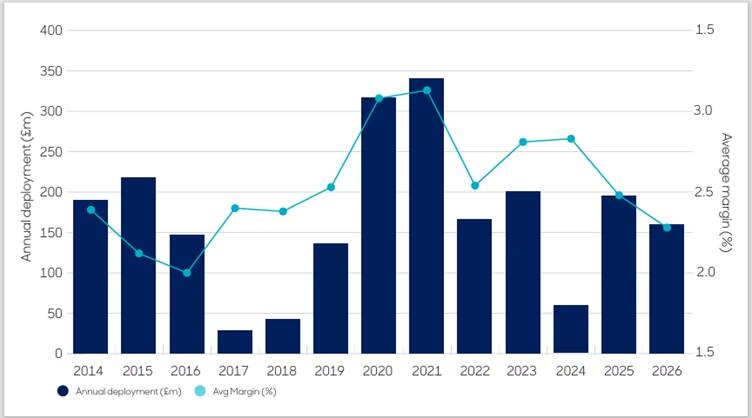
We have been through comparable conditions before, and our record since the platform began in 2013 shows how we behave in them. We have deployed more than €3bn for clients at an average spread of 249bps since inception, with a 0% loan loss rate.7
Annual deployment volume and average margin 2014-2026 year-to-date
Source: Aberdeen, 2026.
- Restraint. Annual deployment fell to just £28m in 2017 and £43m in 2018, before rising as conditions changed.
- Scale in dislocation. In 2020 and 2021 we deployed more than £650m, about a third of everything deployed between 2014 and 2025, at average margins above 300bps in both years. The 2014 to 2019 average was around 230bps.
- Opportunity after the rate shock. We deployed more than £250m across 2023 and 2024 as higher rates and property repricing affected the market.
- Discipline throughout. Long-term average underwriting has been at around 50% LTV, with no loan losses since inception.
This is what a counter-cyclical lender looks like in practice: cautious when the market is hot, and willing to move at scale when others cannot. It is a large part of why we have confidence in the 2027 view.
Why real estate debt is not direct lending
Real estate debt is often grouped with corporate direct lending under the private credit label, but the two are at different points in their cycles. In the US, the largest direct lending market, unitranche all-in yields fell by 109bps during 2025 and are 308bps below their July 2023 peak.8 The private credit default rate reached a record 6.0% by May 2026, and in the first quarter non-traded business development companies received around $14bn of redemption requests, with the first net outflow on record.8 Loans written in 2021 and 2022 are meeting higher borrowing costs and approaching maturities.8
Real estate debt has already had its repricing. Collateral values have reset, the lender is secured on a physical asset that can be independently valued, and the LTV and covenants are set at the outset. A corporate lender relies instead on forecasts of a business’s future cash flow. CREL is not immune; the distinction we draw is one of entry point and selectivity, not immunity.
What 2027 could deliver
Loans are priced off base rates and gilt yields, so higher rates flow directly into income. Gilt yields are around 4.7% at two years and 5.2% at ten.5 For high-quality transactions we expect investment grade loans to deliver 6% to 7% and high yield loans 7% to 9%. Since 2018 our average illiquidity premium over similarly rated public credit has been 155bps,7 and we are regularly securing deals that deliver 150bps to 200bps over equivalently rated public credit of similar duration. These are expectations in current conditions, not guarantees.
Conclusion
Three conditions are lining up for lenders in 2027. Collateral values have already reset, so loans will be struck against a lower base. Rising interest rates will impact property valuations and put interest cover from rental income under pressure. And real estate debt is at an earlier and better-supported point in its cycle than corporate direct lending and many other private credit asset classes.
Together these conditions point to a rare entry point, and as a result we expect 2027 could be one of the most compelling years to invest in real estate debt.
Our own record supports this. We have been cautious when markets were hot and have deployed at scale when others retreated. For investors weighing where private credit fits, we believe real estate debt deserves a place in that conversation now.
Next steps
To find out more about commercial real estate lending investment with Aberdeen Investments, contact one of our team or visit our website.
Risk warning
For professional investors only – not for use by retail investors or advisers.
The value of investments, and the income from them, can go down as well as up and an investor may get back less than the amount invested. Past performance is not a guide to future results.
abrdn Investments Limited, registered in Scotland (SC108419) at 1 George Street, Edinburgh EH2 2LL. Authorised and regulated by the Financial Conduct Authority in the United Kingdom.
Sources
1. RICS UK Valuation Dashboard, June 2023, citing CBRE capital value data.
2. MSCI UK Quarterly Property Index, December 2022 (MSCI, 3 February 2023).
3. Aberdeen; Green Street European Commercial Property Price Index (April 2026 and later updates). Scenario analysis is illustrative. House View per Aberdeen, October 2026.
4. Bank of England; market pricing and Reuters economist poll as reported by HomeOwners Alliance, 3 November 2026.
5. Financial Times market data, UK 10-year gilt yield, 4 November 2026; SalaryWise, UK gilt yield curve, 4 November 2026 (2-year yield).
6. Capital Economics, UK Commercial Property Outlook, 6 October 2026; Colliers, UK Real Estate Investment Forecasts Q3 2026.
7. Aberdeen, June 2026 and October 2026. Spread excludes arrangement fees. Forecast returns and illiquidity premia are expectations in current conditions and are not guaranteed.
8. Houlihan Lokey, U.S. Private Credit Market Newsletter, January 2026; Aranca, Private Credit Direct Lending Report, July 2026 (citing Fitch); Valuation Research Corp, Q3 2026 Private Credit Update.