


As institutional investors look to diversify their investment-grade portfolios and boost returns, attention is increasingly shifting toward alternative fixed income strategies, says the Aegon AM ABS team.
In this paper we examine the role of asset-backed securities (ABS) within Local Government Pension Scheme (LGPS) portfolios, focusing on their characteristics, risk-return profile, and strategic fit within the evolving LGPS investment landscape.
Looking beyond traditional fixed income assets
A combination of stronger funding positions and rising cashflow requirements has led many LGPS to gradually de-risk their portfolios. Traditionally, this has involved reallocating capital into conventional fixed income assets – primarily government and corporate bonds.
However, as allocations to these markets increase, the need for broader diversification becomes more important. Beyond diversification, investors are also contending with spread compression across traditional fixed income markets, further strengthening the case for exploring opportunities outside core bond exposures.
Asset-backed securities (ABS), already a popular choice among many private sector defined benefit pension schemes, have been gaining traction across the LGPS in recent years. Before exploring the investment case, we begin with a brief overview of what ABS entails.
Defining ABS
Asset-backed securities are loans that are covered by specific collateral pools. The European ABS market is both large and diverse – at over £1tn in size, it is comparable to the European investment-grade corporate credit market. It offers a wide range of investment opportunities across geographies and underlying sectors, including residential mortgages, consumer loans, commercial real estate, and corporate lending.
Often associated with a sea of acronyms, we’ve distilled the essentials below.
RMBS (Residential Mortgage-Backed Securities): Includes thousands of individual residential mortgage loans in each pool. Investors receive payments derived from the interest and principal repayments of the underlying mortgages within the pool, typically a few thousand mortgages.
Consumer ABS: Includes auto loans, credit card receivables and student loans. As borrowers make payments on their loans, those payments are passed through to ABS investors. Each issuance typically contains tens of thousands of individual loans, providing a high level of diversification across borrowers.
CMBS: Commercial Mortgage-Backed Securities are similar to RMBS except the bonds are backed by commercial mortgages, rather than residential mortgages.
CLOs: Collateralised Loan Obligations are backed by a pool of corporate loans (leveraged loans). A CLO is actively managed by a CLO specialist manager and typically has around 200-400 individual loans from unique borrowers.
Below, we illustrate the breadth of the European ABS asset pool – a diverse opportunity set for us as asset managers to invest in.
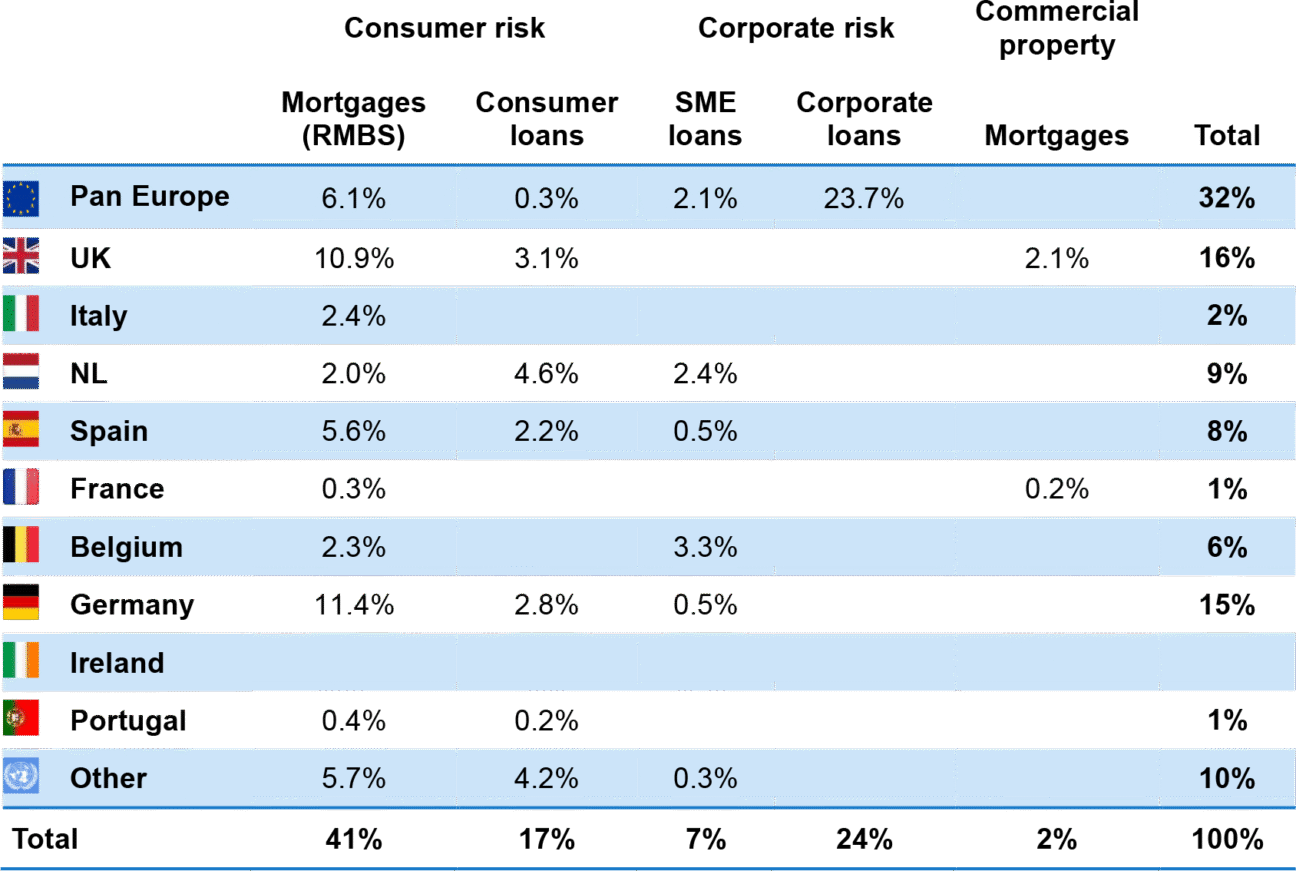
Source: AFME, data to end of Q3 2025 (correct as of 8 January 2026). Please note the difference in total is due to rounding.
The typical structure of an ABS is shown in the chart below, using £1bn of UK residential mortgages as an example. These assets are funded through ABS bonds issued across a capital structure with varying levels of seniority.

Source: Aegon AM. For illustrative purposes only.
The most senior tranche typically receives a AAA rating, followed by AA, A, BBB, BB, and B-rated bonds, with ABS equity sitting at the bottom. Investors can select their preferred level of risk and return – those at the top benefit from greater credit protection and lower yields, while those lower down the structure take on more risk in exchange for higher potential returns.
Why invest in ABS?
Below, we highlight some of the key reasons why ABS is likely to appeal to LGPS.
Attractive yield. European ABS offers investors a substantial yield pick-up versus other traditional fixed income asset classes. A yield premium exists for the following reasons:
Complexity premium: ABS is often overlooked by investors as it can be more structurally complex to understand than traditional FI assets. Furthermore, the asset class is often misunderstood by investors who associate ABS with the financial crisis.
Solvency II: Due to Solvency II regulations, insurers are required to hold substantial capital in comparison to some other fixed income instruments when investing in ABS and, as a result, there is less appetite from insurers to hold ABS.
ECB asset purchases: The ECB asset purchasing programme largely concentrated on buying sovereign bonds and corporate credit, with little focus on the ABS market. This has resulted in spread compression across traditional fixed income markets, whilst the ABS market – which is less crowded – has maintained a higher relative yield.
Low default rates. Investor protections in ABS are built into the structure to reduce default risk. These include credit enhancements like over-collateralisation and excess spread, diversification across thousands of loans, and legal safeguards that enforce transparency and responsible underwriting. Senior tranches are also shielded by subordinated layers that absorb losses first. We have had zero defaults in our European ABS Fund since its inception in 2004.
Low interest-rate sensitivity. Unlike conventional bonds with fixed coupons, almost all European ABS bonds are floating-rate notes with a very short interest rate duration. This makes ABS returns less sensitive to interest rate changes and helps provide greater stability of returns.
Diversification. The cash-flows produced by ABS bonds are typically generated by the underlying consumers paying their mortgages, car loans and credit cards. This is complementary to sovereign and corporate exposure, both of which tend to be well-represented within LGPS portfolios. ABS has a low, or even negative, correlation with many traditional asset classes; this is particularly helpful during times of market stress. Although ABS isn’t immune to market stress, it does offer a degree of diversification to traditional fixed income markets.
Transparency. ABS is highly transparent with investors receiving loan-level data on the asset pool. These are important inputs used within our proprietary models and tools, which help form our investment decisions.
Why Aegon AM?
Aegon AM has a specialist ABS investment team of over 20 professionals, nine of which focus exclusively on European ABS – making it one of the largest dedicated ABS teams in the market.
We have been investing in European ABS since 2001 and managing dedicated portfolios for third-party clients since 2004. Today, we manage around £18.5bn in ABS globally, of which £10bn is in European ABS.
We have built a strong reputation in managing a range of ABS portfolios, from conservative AAA mandates to the higher-yielding ABS Opportunity strategy, which is predominately invested in sub-investment grade ABS.
| European AAA ABS* | European IG ABS | ABS Opportunity | |
| Average credit quality | AAA | AA/A | BB |
| Spread over SONIA | 109 bps | 158 bps | 484 bps |
| Modified Duration | <0.5 | <0.5 | <0.5 |
| Spread duration | ~4 | ~3 | ~5 |
| Vehicle | seg | UCITS, seg | QIF, seg |
Source: Aegon AM, 31 December 2025. * Subject to UK’s Overseas Funds Regime (OFR) registration.
For Professional Investors only and not to be distributed to or relied upon by retail clients.
This is a marketing communication. Please refer to the following legal documents of the UCITS before making any final investment decisions. For UK investors: This product is based overseas (Ireland) and is not subject to UK sustainable investment labelling and disclosure requirements. Please read the Key Investor Information, Prospectus, Supplementary Information Document and Application Form carefully. Consider getting financial advice if you need help to understand the investment and both the risks and opportunities involved. This product is authorised overseas but not in the United Kingdom and the Financial Ombudsman Service is unlikely to be able to consider complaints related to the product, its operator or depositary. Any claims for losses relating to the operator or depositary of this product are unlikely to be covered under the Financial Services Compensation Scheme. For EU investors: please refer to the Prospectus and the PRIIPs KID. The relevant documents can be found at aegonam.com. The principal risk of this product is the loss of capital.
Past performance does not predict future returns. Outcomes, including the payment of income, are not guaranteed.
Opinions and/or example trades/securities represent our unders.tanding of markets both current and historical and are used to promote Aegon Asset Management’s investment management capabilities: they are not investment recommendations, research or advice. Sources used are deemed reliable by Aegon Asset Management at the time of writing. Please note that this marketing is not prepared in accordance with legal requirements designed to promote the independence of investment research and is not subject to any prohibition on dealing by Aegon Asset Management or its employees ahead of its publication.
All data is sourced to Aegon Asset Management unless otherwise stated. The document is accurate at the time of writing but is subject to change without notice. Data attributed to a third party (“3rd Party Data”) is proprietary to that third party and/or other suppliers (the “Data Owner”) and is used by Aegon Investment Management B.V. under license. 3rd Party Data: (i) may not be copied or distributed; and (ii) is not warranted to be accurate, complete or timely. None of the Data Owner, Aegon Investment Management B.V. or any other person connected to, or from whom Aegon Investment Management B.V. sources, 3rd Party Data is liable for any losses or liabilities arising from use of 3rd Party Data.
Aegon Asset Management Europe ICAV is an umbrella type open-ended investment company with variable capital, registered in the Republic of Ireland (Company No. C153036) at 25-28 North Wall Quay, International Financial Services Centre, Dublin 1. Board of Directors: M. Kirby, S. Donald and B. Wright. Aegon Asset Management Europe ICAV is regulated by the Central Bank of Ireland. Aegon Investment Management B.V (Aegon AM NL) is the appointed management company. Aegon AM NL is registered with and supervised by the Dutch Authority for Financial Markets (AFM).
Aegon AM UK markets AAMICI in the UK and otherwise outside of the EEA. Aegon Asset Management UK plc (Aegon AM UK) is authorised and regulated by the Financial Conduct Authority.
Please note that not all sub-funds and share classes may be available in each jurisdiction. This content is marketing and does not constitute an offer or solicitation to buy any fund(s) mentioned. No promotion or offer is intended other than where the fund(s) is/are authorized for distribution.
AdTrax: 8639459.1. | Expiry: 30 June 2026