


Pemberton Asset Management’s Sherilee Mace assesses the power of private credit as LGPS funds look to tilt from growth assets towards income.
Introduction
Funding levels at 2025 valuations are expected to show LGPS funds in a healthy position, with more funds above 100% than in previous valuations. However, cashflow management is becoming an area of increased strategy focus as negative cash flows are predicted to feed through over the coming years.
This requires a re-think of growth, income and protection. Many LGPS funds are looking to tilt from growth assets towards income, especially through assets that have a link to inflation. Although the 2025 scheme valuation will inform future investment strategy and contribution rates, careful monitoring of cash flows will be critical.
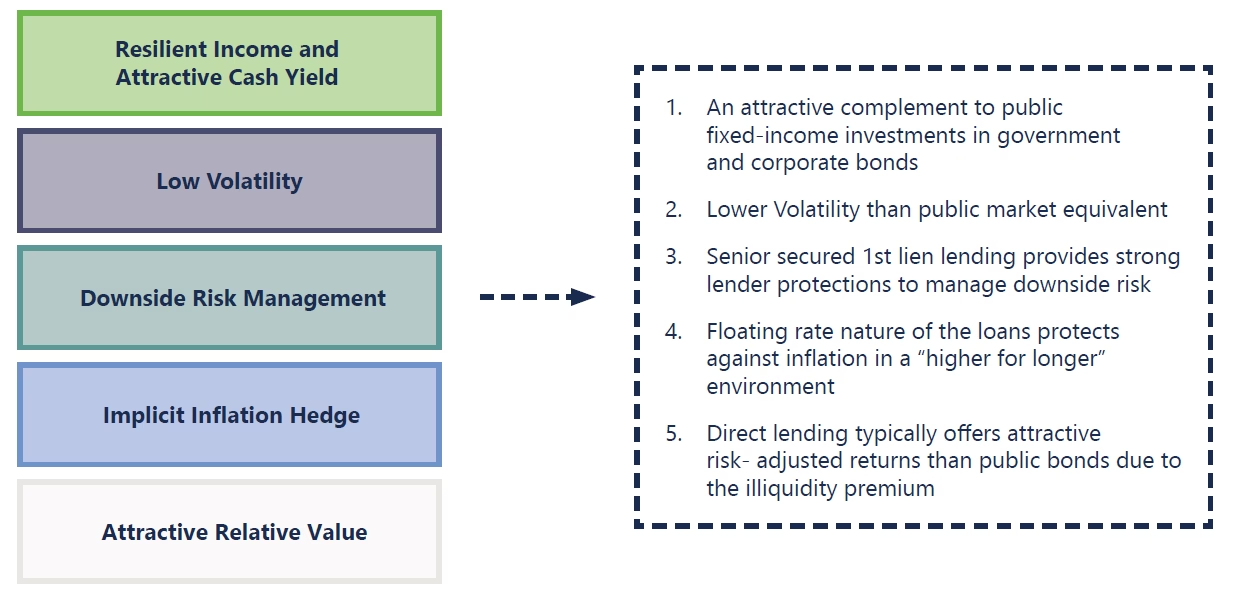
Private credit typically offers:
• Higher yields than those on offer from similarly rated public fixed income assets.
• Diversified income streams by geography and sector.
• Implicit linkage to inflation due to the floating rate nature of most loans because interest rates tend to rise in inflationary environments.
• Strong downside protections. This reflects the greater control private lenders have over the underlying cash flows of the assets backing their loans.
Within private credit, Europe is a particularly attractive choice. Its private credit market is fragmented by geography, regulation and language – inbuilt complexity that limits competition, allowing local lenders with deep networks to maintain pricing power and underwriting standards. Relative value is also excellent at the moment, with spreads of sterling investment grade credit over gilts historically tight.
The maturing of the asset class
European private credit has grown strongly since the financial crisis as banks retrenched, due to regulatory changes requiring additional capital to be lent to sub-IG companies. This has created a funding gap for mid-market and smaller companies.
At the same time, increasing private equity investment drove growing demand for alternative ways to fund buyouts. Private credit has expanded into this gap, creating opportunities for investors who select managers with in-depth experience of the leveraged finance industry.
European mid-market companies are a major engine of economic growth, employing nearly one in six people and generating around 17% of economic output. Targeting finance at these companies, as private credit funds do, helps drive economic growth and innovation.
From the investor’s perspective, these mid-market businesses are also relatively less exposed to US tariffs than larger global companies because they export less of their production to the US.
Today, private credit is seemingly no longer just a high-yield proxy but a mature asset class. Evergreen fund structures have emerged, enabling investors to maintain constant allocations and private credit now spans multiple strategies with differing risk/return profiles.
This delivers a more diverse set of income streams, including a growing share of investment grade assets.
European private credit’s appeal for investors
Europe’s private credit market has significant growth headroom. Penetration of private credit in Europe is much lower than in the US, due to the maturity of the asset class and the breadth of the market. Non-bank lending in Europe and the UK, including corporate bonds and direct lending, makes up just 12% of the corporate finance market, versus 75% in the US. However, with far fewer European private credit funds than in the US, competition for deals is less intense and returns remain strong. In the US, by contrast, private credit is becoming saturated, and some large LPs have started to pull back amid concerns that underwriting standards have slipped as funds compete to secure deals.
In Europe, private credit offers net returns typically range from around 6% up to 13% in GBP, depending on the strategy.
Direct lending to mid-market companies currently offers c. 8%-10% net in GBP, coupled with much stronger protections than on loans to larger private companies. Instead of covenant lite deals, mid-market loans are generally well covenanted with lender-friendly documentation, which allows early intervention from a private credit manager to negotiate further equity support, liquidity injections or greater control should it be needed in the case of a company restructure.
And in cases where borrowers underperform, private credit funds, including Pemberton’s, are typically in a strong position as the sole lender. This gives them good visibility and enables them to pursue a favourable outcome for both clients and the borrower, protecting their LPs’ capital.
Private credit as a pillar of LGPS asset allocations
Why Pemberton?
For over 10 years, Pemberton’s European mid-market strategies, including allocations from LGPS funds and their pools, are in line or above benchmark. This is the result of having experienced leveraged finance teams and local origination in offices across Europe, which is key for building relationships and seeing deals before they reach London. Our broad network is complemented by conservative underwriting and loan documentation that includes strong downside protections.
We offer a range of direct lending strategies within private credit including mid-market debt (with an average credit rating at opening of B), senior loans (average rating B) and strategic capital (average BB-). Alongside these we provide investment grade products including NAV Financing to LBO funds in the mid to upper mid-market, GP Solutions for PE firms and Risk Sharing, which helps European banks unlock capital tied up in their balance sheets.
Since December 2019, when the Sustainable Finance Disclosure Regulation (SFDR) was published, all of Pemberton’s direct lending strategies have been Article 8 certified. Responsible investment is an integral part of the investment approach, with a focus on key ESG risks across the companies we back, including improved reporting of carbon metrics, an area that is important for LGPS clients.
Between them, we believe these strategies offer a range of risk/return profiles that can deliver the strong cash yields and link to inflation that LPs find attractive to address their increasing cash flow requirements.
Contact Sherilee Mace, executive director and head of local government pension scheme, business development at Pemberton Asset Management here: [email protected]
This document is intended only for the person to whom it has been delivered and is solely for discussion / information purposes.
Any third-party information (including any statements of opinion and/ or belief) contained herein is provided by Pemberton Capital Advisors LLP (“we”, “our” or “us”) and has not been independently verified.
Statements of opinion, market or performance information and any forecasts or estimates contained in this document are prepared on the basis of assumptions and conclusions reached and are believed to be reasonable by us at the time.
No representation, warranty, assurance or undertaking (express or implied) is given (and can therefore not be relied upon as such), and no responsibility or liability is or will be accepted by us or any of our affiliates or our respective officers, employees or agents as to the adequacy, accuracy, completeness or reasonableness of the information, statements and opinions expressed in this document. Any opinions expressed in this document do not constitute legal,
tax or investment advice and can therefore not be relied upon as such. Please consult your own legal or tax advisor concerning such matters.
The information contained in this document (which does not purport to be comprehensive) is believed to be accurate only at the date of this document and does not imply that the information herein is correct at any time subsequent to the date hereof and such information is subject to change at any time without notice. The views expressed herein are subject to change based on market and other conditions and we give no undertaking to update the information, to reflect actual events, circumstances or changes in expectations or to provide additional information after its distribution, even in the event that the information becomes materially inaccurate.
The recipient acknowledges and agrees that no person has, nor is held out as having, any authority to give any statement, warranty, representation, assurance or undertaking on our behalf. No part of this document may be reproduced in any manner without our written permission.
This document has been prepared and issued by Pemberton Capital Advisors LLP. Pemberton Capital Advisors LLP is authorised and regulated by the Financial Conduct Authority (“FCA”) and entered on the FCA Register with the firm reference number 561640 and is
registered in England and Wales at 5 Howick Place, London SW1P 1WG, United Kingdom. Registered with the US. Securities and Exchange Commission as an investment adviser under the U.S. Investment Advisers Act of 1940 with CRD No. 282621 and SEC File No. 801-107757. Tel: +44(0) 207 993 9300.
www.pembertonam.com
Pemberton is a registered trademark. © Pemberton