Mark Davies, co-founder of Novum Investment Management shares how the use of options helped one LGPS fund to mitigate the impact of recent stock market volatility.
LGPS are long-term investors for funds that are still open.As a result, they tend to hold growth assets like equities. That is not to say that LGPS are oblivious to the risk of stock market indices falling, as the last few months have illustrated. With LGPS funds now in the midst of their triennial valuation and most funds being fully funded, many funds may be reconsidering their exposure to stock markets.
The most basic way to manage the risk of market falling is to sell equity and wait for the market fall.
This presents two challenges:
- Psychologically, de-risking tends to be a one-way street – it can be very hard to re-risk especially if you don’t need to
- Even if the psychological barrier is overcome then there is a practical one – when to go back into the market
Options aim to solve this by allowing LGPS to manage their equity risk and return without them having to sell equity. In addition, we would propose that the creation of an Options strategy creates a framework that makes it easier to make decisions.
Illustrating options in action using an LGPS case study
We illustrate options in action using a case study of a real fund that implemented options in 2024 and experienced the market rise followed by tariff driven volatility.
Through this case study we will describe:
- The requirements of the LGPS fund
- The option strategy used
- How this strategy was monitored and managed once in place
LGPS options case study
The strategy was implemented in the July 2024.
There were three main objectives of the LGPS:
- To have something that can provide some buffer that can be banked if markets fall
- Not to have to sell equity to manage risk
- To limit the regret risk of having a significant return drag from the strategy especially in rising markets
The strategy was built up logically as follows:
Start with protection – a strategy that will have a positive value if markets fell was essential. The structure of the market pricing at that time meant that limiting the width of the downside risk mitigation did not appear good value for money. This was especially true given the potential of restructuring early in order to bank potential gains if markets fell
Capped strategies ruled out – capping equity returns is one way of “paying” for downside risk mitigation, however this was not selected. The reason being that using our tool Doris we were able to visually explain the potential regret risk in a strong market rise.
Sacrifice in for modest market moves – downside risk mitigation has to be paid for by sacrificing something. Through our discussions on Doris, it became clear that a sacrifice for minimal market movements suited the LGPS. This was partly because such modest moves and the sacrifice involved would not materially affect the funding position. In addition, the strategy designed (see below) provided a mechanism for limiting this sacrifice
Enhanced upside – The advantage of the sacrifice chosen was that it not only paid for the downside risk mitigation, but allowed for a strategy that outperformed equities as markets rose strongly.
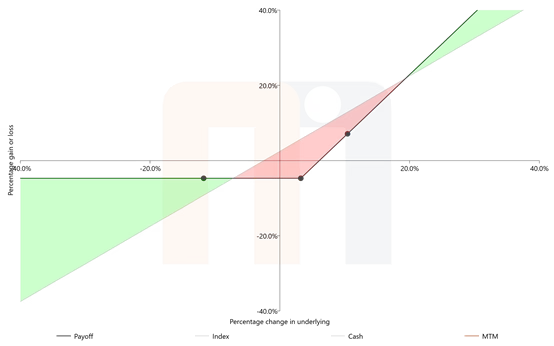
The outcome at maturity of the chosen strategy is shown below
For illustrative purposes only
Monitoring programme
The main challenge with the strategy chosen is the area of sacrifice shown in red.
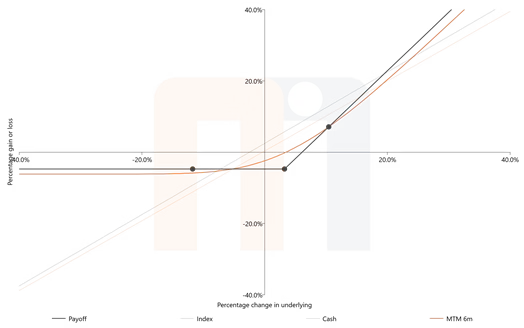
However, the line shown is at maturity. The curved line added below shows the estimated position 6 months into the 12-month strategy.
For illustrative purposes only
This illustrates that the sacrifice only accelerates in the final 6 months of the strategy. This principle formed the basis for the monitoring programme:
- As per the objectives, any significant market fall would trigger a discussion about restructure to bank the value of downside risk mitigation
- Any significant rise would similarly trigger a discussion about banking any enhanced gains over equity
- In the event that nothing happened then the strategy would be restructured after 6 months. This would limit the sacrifice made and market conditions would likely be as such that the strategy could be replaced with a similar one
The monitoring of the strategy was carried out on a daily basis by Novum and the LGPS officers that had delegated authority, kept up to date as required.
If any of the triggers above were approached, it was agreed to have more frequent updates.
Mid-term restructure
Although the market experienced some minor movements they were not significant. As a result, the 6 month restructure trigger was hit.
The negative value of the options represented approximately 2.4% of the value of the equity portfolio. When compared to the rise in equity portfolio of approximately 9% in those six months, it’s clear that the options performed as expected: sacrificing for small market moves, benefitting for large market moves. (source – Novum)
The strategy was replaced with one that was near identical just reset to current market levels.
Tariff volatility restructure
Three months into the restructured strategy, stock market volatility increased as a result of heightened risks of trade wars and the market fall triggers were approached. As pre-agreed, the frequency of updates with officers was increased.
By early April, when the market fall had been significant enough the value of the options had a strong positive value. This provided a trigger in itself for the LGPS to consider whether re-risking into equities was attractive.
At the market levels at the time the LGPS decided that they no longer felt they needed protection and decided to bank the protection.
From making this decision to successfully unwinding the options took less than 24 hours and resulted in a positive options value of 5.7% of the equity portfolio which provided a significant buffer of protection compared to the 13% fall in equity value since the previous restructure. (source – Novum)
At this point the decision was made to rerisk into equity by simply removing the options.
Take aways from the case study
This case study illustrates three key principles of options strategies:
This case study illustrates three key principles of options strategies:
- There are no surprises – you can describe in advance how they will behave in different market conditions. This not only removes surprises but also makes it possible to understand the types of decisions that may need to be made in advance
- The existence of an options strategy provides a decision-making tool that doesn’t exist with a buy/sell equity portfolio. The options have an identifiable value that provides the framework for making a decision
- Using liquid options on large indices means that trading in volatile markets is possible.
This document may only be distributed to professional investors by Mirabella Financial Services LLP, which is authorised and regulated by the Financial Conduct Authority (FRN: 415559).
This marketing communication is intended exclusively for Professional Clients as defined by the UK Financial Conduct Authority (“FCA”) and should not be relied upon by other persons, such as Retail Clients, as defined under the FCA’s Rules. The definitions can be found on the FCA website at www.fca.org.uk . Before making any final investment decisions and to ensure you understand whether any strategies are suitable for you, please refer to the governing documents applicable to the strategy for clarity on compensation and the level of protection afforded to professional clients. For more information please contact [email protected]. This marketing communication may only be distributed to professional clients or eligible counterparties by Mark Davies, Masroor Ahmad or Jason Wood who are seconded to Mirabella Financial Services LLP. This document has been prepared by Novum Investment Management. Novum Investment Management Limited a company incorporated in England and Wales (Company Number 14537642) with the registered address 20th Floor 125 Old Broad Street, London EC2N 1AR.
Novum Investment Management has entered into a series of agreements with Mirabella Financial Services LLP (Mirabella), whereby Novum Investment Management have seconded the services of Mark Davies, Masroor Ahmad and Jason Wood to assist Mirabella with the provision of portfolio management, advisory and ancillary services in relation to the segregated strategies discussed.
- There are no surprises – you can describe in advance how they will behave in different market conditions. This not only removes surprises but also makes it possible to understand the types of decisions that may need to be made in advance
- The existence of an options strategy provides a decision-making tool that doesn’t exist with a buy/sell equity portfolio. The options have an identifiable value that provides the framework for making a decision
- Using liquid options on large indices means that trading in volatile markets is possible.
This document may only be distributed to professional investors by Mirabella Financial Services LLP, which is authorized and regulated by the Financial Conduct Authority (FRN: 415559).
This marketing communication is intended exclusively for Professional Clients as defined by the UK Financial Conduct Authority (“FCA”) and should not be relied upon by other persons, such as Retail Clients, as defined under the FCA’s Rules. The definitions can be found on the FCA website at www.fca.org.uk . Before making any final investment decisions and to ensure you understand whether any strategies are suitable for you, please refer to the governing documents applicable to the strategy for clarity on compensation and the level of protection afforded to professional clients. For more information please contact [email protected]. This marketing communication may only be distributed to professional clients or eligible counterparties by Mark Davies, Masroor Ahmad or Jason Wood who are seconded to Mirabella Financial Services LLP. This document has been prepared by Novum Investment Management. Novum Investment Management Limited a company incorporated in England and Wales (Company Number 14537642) with the registered address 20th Floor 125 Old Broad Street, London EC2N 1AR.
Novum Investment Management has entered into a series of agreements with Mirabella Financial Services LLP (Mirabella), whereby Novum Investment Management have seconded the services of Mark Davies, Masroor Ahmad and Jason Wood to assist Mirabella with the provision of portfolio management, advisory and ancillary services in relation to the segregated strategies discussed.